Introduction
Planetary gear motors look straightforward on a datasheet: pick a ratio, check rated torque, move on. In the real world, that’s how you end up with overheated windings, noisy gearboxes, worn bearings, and “mysterious” early failures.
Derating is the disciplined step that closes the gap between catalog conditions and your actual operating envelope. It forces you to translate a messy load profile into a torque-and-thermal reality check, then confirm that the gearbox and its bearings will live long enough to make your field reliability targets.
Most catalogs are built around assumptions that rarely match your application exactly:
~25°C ambient (or another stated baseline), stable airflow
Nominal mounting and lubrication orientation
Catalog speed/torque measured at controlled conditions
In this guide, you’ll get a practical framework for planetary gear motor derating, a set of mechanical and thermal checks, and a validation workflow you can use before sourcing and release.
Build your planetary gear motor derating framework
Define loads, duty, and service factor
Start with what the gearbox “sees” at the output shaft:
Required output torque over time (not just one number)
Output speed over time
Starts/stops per hour, reversals, and any impact events
Ambient temperature range and airflow constraints
Mounting orientation and heat sinking (if any)
Then apply a service factor (SF) to translate “what the application needs” into “what the gearmotor must be rated for.” A service factor is commonly defined as the ratio of rated gearbox capacity to the application-required capacity, used to account for shock loads, duty severity, and load variability (see Motion Control Tips’ explanation of “Gearbox service factor and service class”).
A practical sizing rule (torque form) is:
Rated continuous torque ≥ (application continuous torque) × (service factor)
If you only have a single “required torque” number, you’re still better off than skipping derating—but you’ll want to convert that single value into a duty-aware model as soon as possible.
⚠️ Warning: Treat service factor as an engineering control, not a procurement knob. Underestimating duty severity often shows up later as heat, noise, and bearing wear—when schedule risk is highest.
Continuous vs peak torque and duty-cycle mapping
Most applications aren’t steady-state. A gearbox might see:
A steady “baseline” torque during normal operation
Short peaks during acceleration, indexing, stall events, or friction spikes
Repeated pulses that drive fatigue even if the average torque looks safe
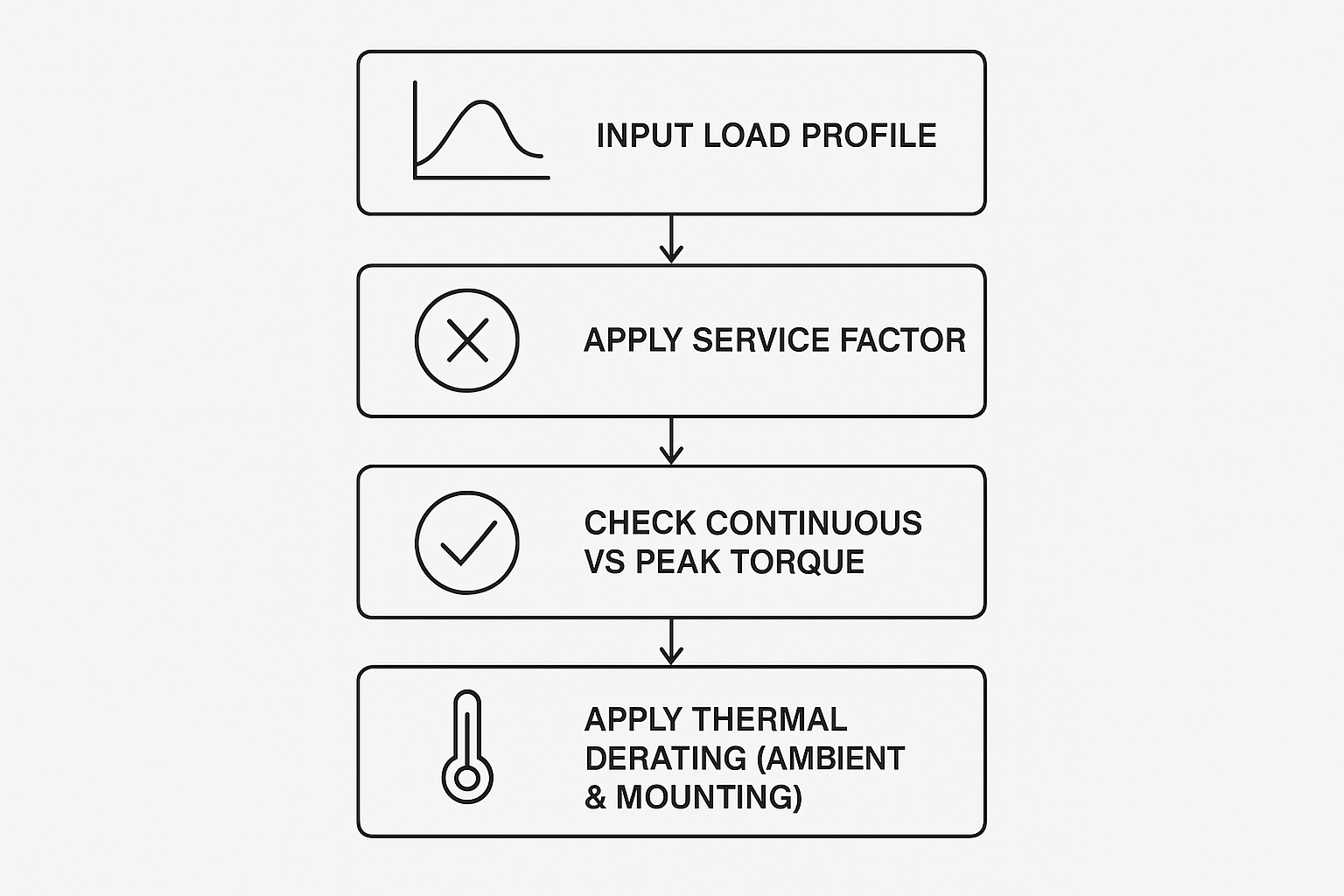
To make this actionable, map the duty cycle into torque bands with time fractions. For example:
60% of time at T1
30% of time at T2
10% of time at T3
From there, separate two decisions:
Continuous check: Is the long-duration portion of the cycle below the allowable continuous torque after derating?
Peak check: Are short events below the allowable peak torque for the specified duration and frequency?
If your vendor provides duty-cycle limits (e.g., peak torque allowed for N seconds per minute), use those exact constraints. If they don’t, default to conservative assumptions and validate with testing.
Thermal limits and ambient/mounting effects
Thermal failures are a classic “everything looked fine on paper” mode.
Even if torque is within mechanical limits, heat can accumulate from:
Gear mesh and bearing losses (efficiency is never 100%)
Motor copper losses under load
Poor convection (enclosures, no airflow)
Mounting orientations that reduce lubrication effectiveness or heat dissipation
Many manufacturers rate thermal capacity at a defined ambient (often 20–25°C), and require derating above that baseline. For example, SEW‑Eurodrive specifies ambient-related derating guidance in “Derating due to the ambient temperature”, illustrating how continuous capability can drop as ambient rises. The concept of a gearbox’s thermal capacity—how much power it can transmit continuously without overheating—is also commonly discussed as a separate limit from mechanical rating (see All Torque Transmissions’ overview of “Gearbox Thermal Capacity”).
Thermal derating is not a single universal percentage. It’s a workflow:
Identify the catalog thermal baseline conditions.
Convert your ambient + enclosure + airflow into a realistic dissipation condition.
Reduce continuous torque/power until the system reaches thermal equilibrium.
Validate with instrumented testing (temperature and current).
Respect gearbox and bearing limits
Output speed and efficiency boundaries
Stay inside the manufacturer’s rated input speed and output speed limits for the chosen ratio. If you’re near a boundary, treat it as a risk flag and ask for vendor confirmation of thermal margin and lubrication suitability in your exact mounting orientation.
Also remember the system-level reality: if the gearbox is inefficient at a given ratio/load, the motor must supply more input power, which raises current and heat. That’s why a torque-only selection can still overheat.
Radial/axial load and overhung moment checks
A planetary gearbox can meet torque requirements and still fail early if the output shaft loads are ignored.
Common culprits:
Belt tension on a pulley
Chain tension on a sprocket
Side loads from misalignment or rigid couplings
Axial thrust from lead screws or pressed fits
Two rules of thumb:
Radial (overhung) load is distance-sensitive: the same force applied farther from the gearbox face creates a much larger moment at the bearing.
Combined loading matters: axial thrust + radial load can reduce bearing life dramatically compared to either load alone.
Oriental Motor provides a clear application-oriented explanation of how to think about these forces and why distance matters in “Motor Sizing Basics Part 4 — Radial Load and Axial Load”. For belt drives specifically, Gates defines overhung load and highlights the reliability consequences when limits are exceeded in the whitepaper “How Belt Drives Impact Overhung Load”.
Your check should be explicit:
Compute radial force (Fr) and axial force (Fa) at the point of load application.
Compute the overhung moment M = Fr × L (lever arm from bearing reference).
Compare Fr/Fa/M to the manufacturer’s permissible values at that distance.
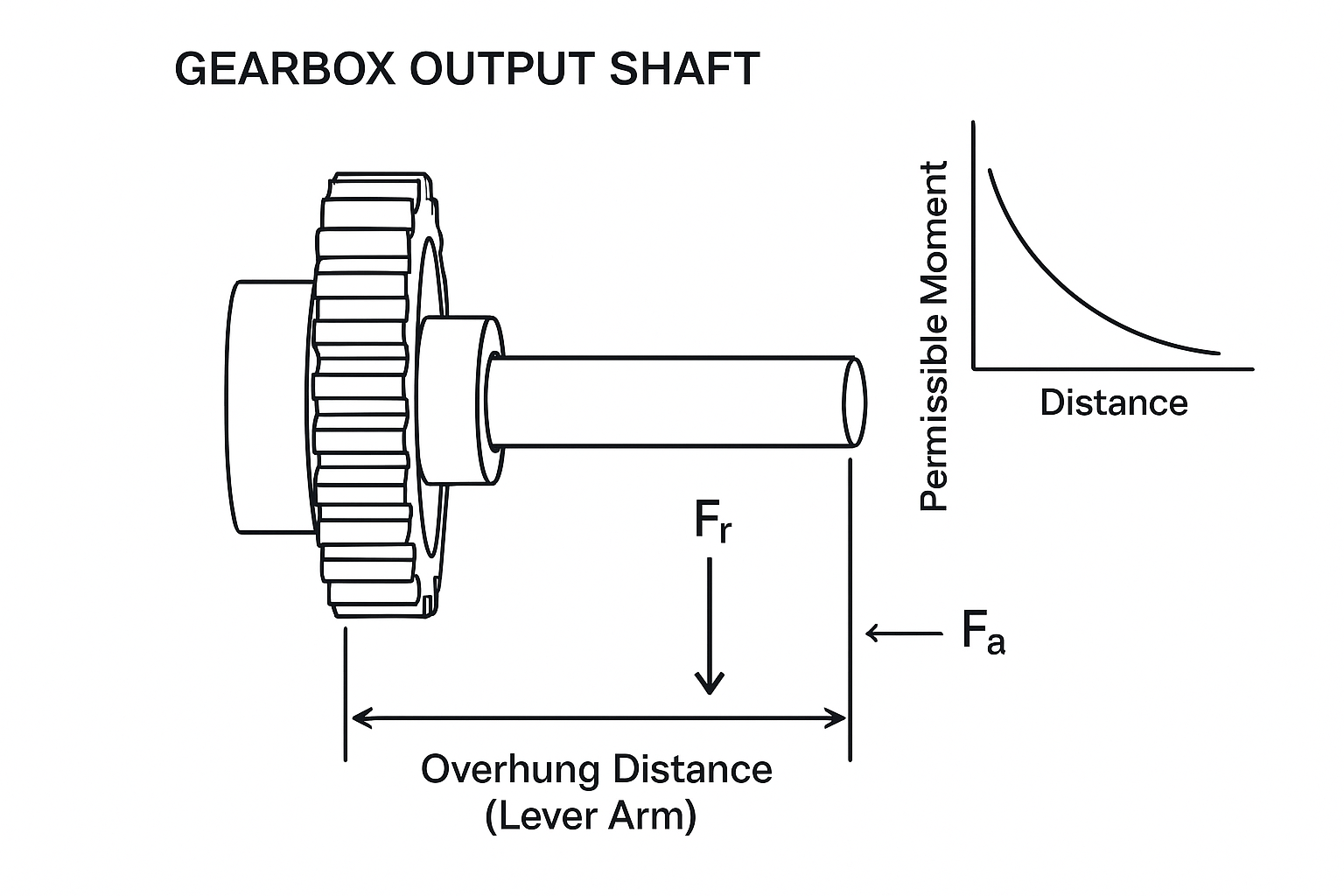
Pro Tip: If you’re close to the limit, reduce the lever arm first. Moving the pulley/sprocket closer to the gearbox face often buys more life than upsizing torque rating alone.
Shock/vibration and life considerations
Shock loads and vibration don’t just “add torque.” They change failure modes:
Micro-pitting and accelerated gear tooth wear
Bearing brinelling or early spalling
Loosening fasteners and coupling elements
Noise growth over time (a practical early warning)
Treat these as design inputs:
Define shock events explicitly (what causes them, how often they occur)
Increase service factor for high start/stop rates, reversing motion, or impact loads
Validate mounting stiffness and alignment (a flexible coupling doesn’t fix a bending shaft)
If your reliability target is long life under repeated cycling, plan for bearing life, not just “it runs today.”
Verify with data and prototypes
Read curves, apply safety margins, log assumptions
A derating decision is only as good as its assumptions.
Before prototypes, document (in a simple sizing sheet) at least:
Ambient baseline and worst case
Mounting orientation
Duty cycle torque bands + durations
Service factor used and why
Continuous torque margin (%)
Peak torque margin (%)
Radial/axial/moment margin (%), at the actual lever arm
If the vendor provides torque-speed curves, efficiency curves, or thermal curves, use them—and keep a record of the exact version/date of the document.
Instrument temperature/current; test worst-case cycles
Bench tests should be designed to “break the assumptions,” not confirm the happy path.
Minimum instrumentation:
Motor current (RMS and peak)
Case temperature (motor and gearbox) at steady state
Ambient temperature near the assembly
Test sequence:
Run your worst-case duty cycle until temperatures stabilize.
Repeat at worst-case ambient (or simulate with an enclosure/heater).
Include the worst mechanical loading condition (e.g., max belt tension, max axial thrust).
If temperature is still trending upward after the expected stabilization window, treat it as a thermal-failure indicator even if torque is nominal.
Vendor validation and customization support
Once your calculations and first test data exist, use the vendor as a second set of eyes—especially when you’re near boundaries.
For example, INEED Motors can support non-promotional engineering validation steps such as:
Application review of your torque/speed/duty assumptions
Custom shafts to reduce overhung load leverage or fit packaging constraints
Integrated encoders for closed-loop control and more accurate duty-cycle verification
Custom gear ratios to move operating points away from thermal or efficiency edges
The key is to bring your logged assumptions and test data to the conversation so any recommendations are tied to measurable constraints.
Conclusion
Derating isn’t pessimism—it’s how you turn a catalog selection into a reliable, testable design.
Key takeaways for safe planetary gear motor derating:
Start from the real duty cycle, not a single torque number.
Apply service factor intentionally and document why.
Treat thermal limits as a first-class constraint; ambient and mounting can dominate.
Verify radial/axial loads and overhung moment at the actual lever arm.
Validate with instrumented worst-case testing before you lock sourcing.
Final checklist before sourcing and release:
Duty cycle defined (continuous + peak events)
Service factor chosen and justified
Continuous torque margin confirmed after thermal derating
Peak torque within allowed duration/frequency
Output speed within rated limits for the ratio
Radial/axial/overhung moment verified at real geometry
Temperature/current instrumented test passes worst-case cycle
Assumptions and curve versions logged for design history
FAQ
What is “derating” for a planetary gear motor, and when do I need it?
Derating is the process of reducing the catalog-rated torque or power to reflect your real operating conditions—especially higher ambient temperature, limited airflow, non-ideal mounting orientation, or a non-steady duty cycle. You should derate anytime your application includes repeated peaks, frequent starts/stops, enclosure heat buildup, or when you’re operating close to the gearbox’s torque or thermal limits.
How do I choose a service factor without oversizing the gearbox?
Start by translating the real duty cycle into continuous and peak torque events, then select a service factor based on shock severity, start/stop frequency, reversals, and load variability. If your system has impacts or aggressive indexing, use a higher service factor; if it’s smooth and steady, you can stay closer to baseline. The goal isn’t maximum oversize—it’s a documented margin that you can validate with temperature/current testing and noise/wear observations.
Why can a gearbox fail even if output torque is below the rated value?
Because torque rating alone doesn’t protect you from thermal overload or bearing damage. A planetary gearbox can overheat when losses accumulate (low airflow, high ambient, poor heat sinking), and the output bearings can fail early if radial/axial loads or overhung moment exceed limits—common with pulleys, sprockets, misalignment, or screw thrust. Always check thermal equilibrium and shaft loading (Fr/Fa and lever arm) in addition to torque.