You want to choose a gear motor for your robotic arm that delivers power, speed, and reliability. Smart selection starts when you focus on torque, speed, inertia, and weight. Many builders face issues like undersizing or oversizing. Here’s a quick look at common mistakes:
Mistake Type | Description |
|---|---|
Undersizing | Inadequate safety factors, low starting torque, ignoring environment |
Oversizing | High cost, low efficiency, increased inertia |
Follow these steps to avoid these pitfalls and build a better robotic arm.
Key Takeaways
Calculate the torque and speed needed for each joint of your robotic arm. Use formulas to ensure accurate motor selection.
Choose the right gear ratio to balance torque and speed. A higher ratio increases torque for heavy lifting, while a lower ratio boosts speed for quick movements.
Optimize the size and weight of your gear motor. Select motors with high torque density to keep your robotic arm agile and efficient.
Test gear motors before final selection. Running tests with actual loads helps confirm performance and avoid surprises after installation.
Source gear motors from reliable suppliers. Trusted companies provide quality parts and support, ensuring a smoother project experience.
1. Match Specs to Joint Needs
Calculate Torque and Speed
To choose a gear motor for your robotic arm, you must first calculate the torque and speed needed for each joint. Torque measures the rotational force, while speed tells you how fast the joint moves. Follow these steps for accurate motor selection:
Understand torque as the force that turns your robotic arm joint. Use the formula: τ = F × r × sin(θ).
Identify the load your joint will carry, including both static and dynamic loads.
Separate static torque (holding a load at rest) from dynamic torque (moving a load).
Calculate static torque using: Torque_static = Weight × Distance.
Find dynamic torque with: Torque_dynamic = Inertia × Angular_acceleration.
Add friction and efficiency factors to your calculations.
Select a gear motor that meets your torque and speed needs and fits your design.
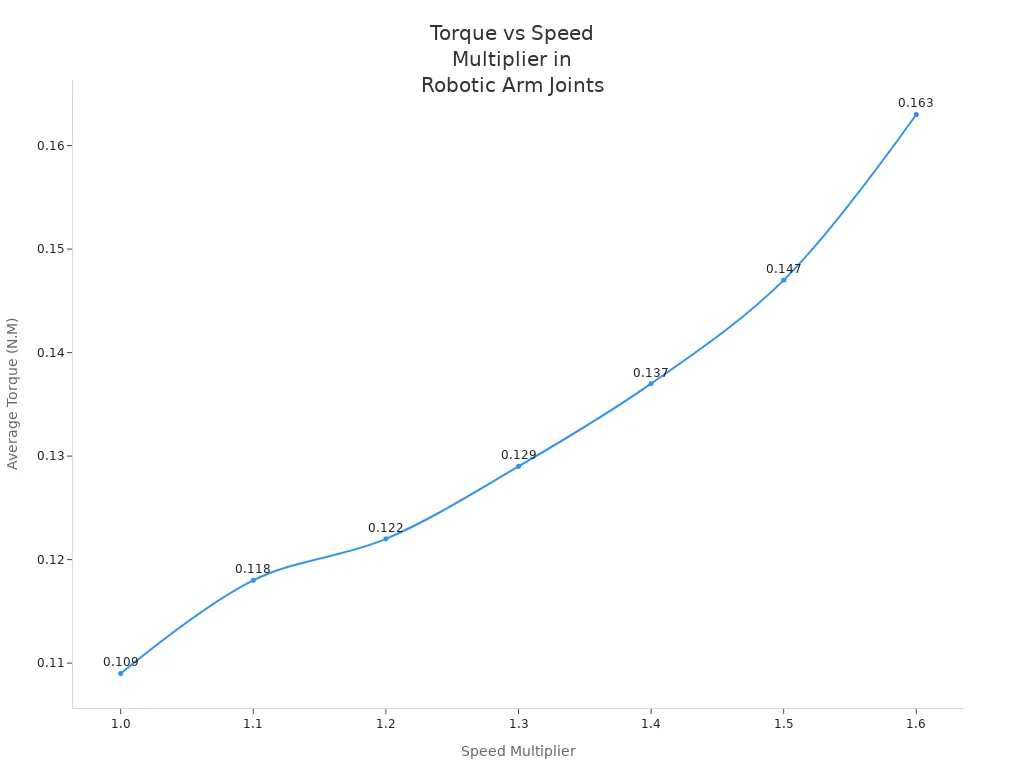
Industry benchmarks help you compare your results. The table below shows average torque and speed multipliers for robotic arm joints:
Speed Multiplier | Average Torque (N.M) | Average Current (A) |
|---|---|---|
1.0 | 0.109 | 0.473 |
1.1 | 0.118 | 0.511 |
1.2 | 0.122 | 0.550 |
1.3 | 0.129 | 0.561 |
1.4 | 0.137 | 0.569 |
1.5 | 0.147 | 0.571 |
1.6 | 0.163 | 0.572 |
Factor in Inertia and Load
You need to consider inertia and load when you choose a gear motor. Inertia is the resistance to changes in motion. Load includes the weight and mass distribution of the arm and anything it carries.
Perform static weight evaluations to measure gravitational pull.
Use dynamic mass simulations to account for extra loads during acceleration.
Assess kinematics burden by checking speed, mass distribution, and center of gravity.
Use online payload calculators to enter weight and mass details.
Try FEA simulation tools to find stress points and optimize your design.
Calculate the moment of inertia based on mass, shape, and distribution.
These steps help you achieve high torque output and reliable power delivery.
Apply Safety Margins
Safety margins protect your robotic arm from overload and unexpected stress. You should operate your arm at about half its rated capacity for reliability and longer life. This practice is common in motor selection for industrial and medical robots.
In surgical applications, safety margins are generated around vital anatomy using statistical models of registration uncertainty. This method allows for the adjustment of safety margins based on the specific requirements of the procedure, such as in mastoidectomy, where proximity to critical structures necessitates precise safety thresholds.
Always add a safety factor to your torque and power calculations. This step ensures your gear motor can handle sudden changes and keeps your robotic arm running smoothly. When you choose a gear motor, remember to check gear ratios, output torque, and motor torque for every joint. Servo motors often provide better control and high torque output for demanding tasks.
2. Choose a Gear Motor Ratio for Performance
Select Gear Ratio for Torque and Speed
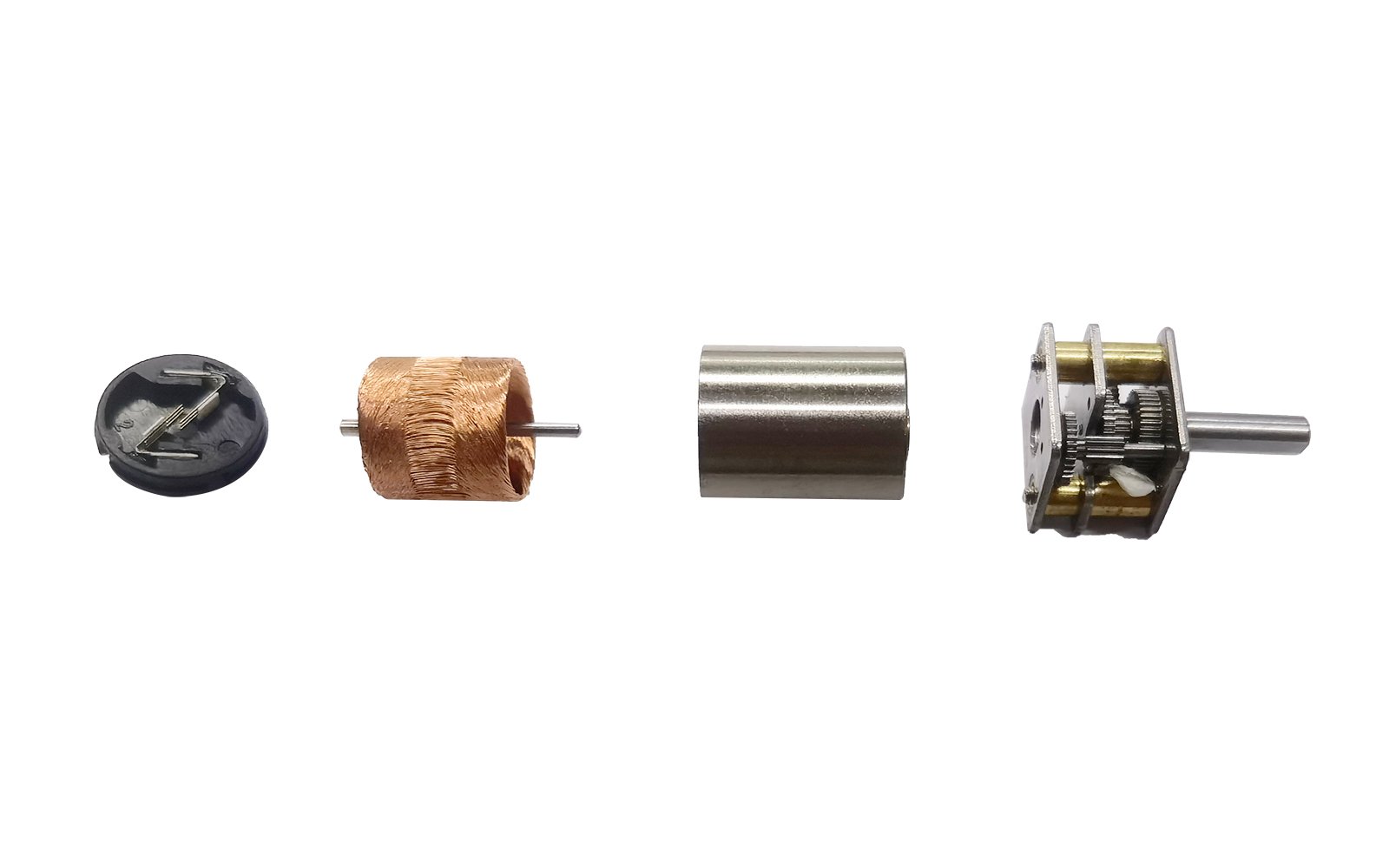
When you choose a gear motor for your robotic arm, gear ratios play a key role in determining torque and speed. You need to match the gear ratio to the demands of your application. A higher gear ratio, such as 100:1, boosts torque output and lowers speed. This mechanical advantage helps your arm lift heavy objects. On the other hand, a lower gear ratio increases speed but reduces torque, which works best for tasks that need quick movements with lighter loads.
A high gear ratio increases torque, letting your robotic arm handle heavier tasks.
A low gear ratio increases speed, making it ideal for rapid, light-duty actions.
Gear ratios directly multiply torque and divide speed. For example, a 4:1 gear ratio gives you four times the torque but only one-quarter of the speed. You should always consider the balance between torque and speed when you choose a gear motor.
Type of Reducer | Typical Gear Ratios |
|---|---|
Cycloidal | 30:1 to 300:1 |
Harmonic Drive | 30:1 to over 300:1 |
Planetary | 1:1 to virtually any value |
Balance Efficiency and Output
Efficiency matters when you choose a gear motor. Gear reduction increases torque and lowers speed through a set of gears. The gear ratio determines how much reduction you get, affecting output torque and speed. High efficiency in gear motors leads to less energy waste and better operational effectiveness. Some models work up to 95% efficiently, reducing energy waste and heat generation. Efficient motors also spread force evenly, minimize friction, and allow your robot to use only the necessary power.
Tip: Optimizing energy consumption in your robotic arm helps you save on costs and supports sustainability in manufacturing.
Gear reduction enables precise movements, which is essential for high precision.
Efficient gear motors contribute to sustainability by optimizing energy use.
Regenerative braking saves energy during deceleration.
Benefit | Description |
|---|---|
High Efficiency | Some models work up to 95% efficiently, reducing energy waste. |
Force Distribution | Spreads force evenly, minimizing friction and energy loss. |
Speed Control | Allows the robot to use only the necessary power. |
Regenerative Braking | Saves energy during deceleration. |
Reduced Heat Generation | Less heat means less wasted energy and cooling requirements. |
Consider Motor Types
Motor selection affects the performance of your robotic arm. You can choose from several types, each with unique advantages:
Stepper motors offer precise control and are easy to integrate.
Servo motors provide high torque output and accurate positioning, making them ideal for demanding tasks.
Frameless torque motors deliver compact size and high power, which helps you maximize torque density.
You should match the motor type to your gear ratios and application needs. Servo motors often work best when you need high torque output and smooth control. Stepper motors suit applications that require repeatable movements. Frameless torque motors help you reduce weight while maintaining power.
When you choose a gear motor, always consider gear ratios, output torque, speed, and power. This approach ensures your robotic arm performs reliably and efficiently.
3. Optimize Size and Integration
Minimize Weight, Maximize Torque Density
You want your robotic arm to move quickly and lift heavy objects without extra strain. Choosing a gear motor with high torque density helps you achieve this goal. Torque density measures how much torque a motor delivers compared to its size and weight. When you select a gear motor, look for models that offer strong lifting capacity for less weight. This approach keeps your arm agile and prevents overload.
Torque density shows how much power you get for each gram or cubic millimeter.
Higher torque density means better lifting and speed for less weight.
The lifting capacity of your manipulator depends on torque at different distances from the base.
If you focus on torque density during motor selection, you can build a robotic arm that performs well and stays lightweight.
Check Mounting and Compatibility
Mounting and compatibility affect how easily you can install or replace a gear motor. You need to check the space available in your robotic arm and choose a motor that fits securely. Different mounting styles, such as flange mounts or foot mounts, make installation easier. Material compatibility also matters, especially when your arm faces vibration or heavy loads.
Space availability
Load and vibration resistance
Ease of installation
Material compatibility
The physical dimensions and mounting configuration of your gear motor play a big role in replacement and upgrades. You should always confirm that your chosen motor fits your design and supports high torque output.
Plan for Easy Maintenance
Regular maintenance keeps your robotic arm running smoothly and extends its life. You should choose gear motors that allow easy access for cleaning, lubrication, and inspection. Maintenance-friendly designs reduce downtime and improve reliability.
Maintenance Type | Key Tasks |
|---|---|
Preventive Maintenance | Recalibrate sensors, clean filters, replace seals, inspect wiring, lubricate joints |
Predictive Maintenance | Vibration analysis, monitor torque and heat, review error logs, analyze grease, use dashboards |
Daily Tasks | Clean dust, verify encoder accuracy, check for leaks, inspect cables |
Monthly Tasks | Re-tighten bolts, recalibrate system, run diagnostics, sample grease, back up programs |
Maintenance-free components and optimized plastic parts increase uptime and reliability. You spend less time on repairs and more time using your robotic arm for productive tasks. When you plan for maintenance, you protect your investment and ensure consistent power and speed.
4. Quick Tips to Choose a Gear Motor
Test Before Final Selection
You should always test a gear motor before making your final choice. Testing helps you confirm that the motor meets your torque and speed needs. Try running the motor with your actual load and observe its performance. Check if the gear motor can handle sudden changes in direction or speed. If you use servo motors, test their accuracy and response time. Testing helps you avoid surprises after installation.
Tip: Use a simple test bench to measure torque, speed, and temperature during operation. This step gives you real data and helps you spot problems early.
Source Reliable Components
Finding reliable sources for gear motors makes your robotic arm project smoother. You can buy from trusted suppliers who offer quality parts and good support. Here are some popular options:
Sparkfun: Offers electronic components and breakout boards. Known for open-source products.
Adafruit: Provides a wide range of electronic components and has international resellers.
INEED: Focuses on affordable power electronics and motor control, especially for brushed motors.
Servo City: Specializes in gears and drivetrains, with affordable aluminum gears and easy integration.
You should build strong relationships with suppliers and manufacturers. Check for quality certifications and standards. If you buy gear motors from overseas, learn about import rules and duties. Online marketplaces and AI tools can help you compare prices and features quickly.
Avoid Common Mistakes
Mistakes in gear motor selection can increase costs and reduce performance. You should avoid choosing a motor that does not match your torque and speed needs. Motors that are too large or heavy can make your robotic arm slow and use more energy. This leads to higher maintenance costs and less mobility.
Mistake | Impact on Project |
|---|---|
Wrong torque/speed | Poor performance, low efficiency |
Oversized motor | High energy use, costly repairs |
You can prevent these issues by testing, sourcing from reliable suppliers, and checking all specifications before buying.
You can build a reliable robotic arm by following three smart steps: match specs to joint needs, choose the right gear ratio, and optimize size and integration. When you use a structured process, you get these benefits:
You match motor features to your system, which boosts performance and accuracy.
Gear ratios increase torque and keep your design compact.
The right motor improves efficiency and lowers maintenance costs.
Many industries, like automotive and medical, have seen big gains by using these methods.
Start your selection process today and watch your robotic arm perform better and last longer!
FAQ
What is the most important factor when choosing a gear motor for a robotic arm?
You should focus on matching the torque and speed requirements for each joint. This step helps you avoid undersizing or oversizing your motor. Always check your application needs before making a decision.
How do you use torque-speed curves in motor selection?
You can use torque-speed curves to compare motor performance at different speeds and loads. These curves help you predict how your gear motor will behave under real working conditions.
Why does gear ratio matter for robotic arms?
Gear ratio changes the balance between torque and speed. A higher ratio increases torque for heavy lifting. A lower ratio boosts speed for quick movements. You should select a ratio based on your task.
How can you reduce maintenance for your gear motor?
You can choose motors with easy access for cleaning and lubrication. Regular checks and preventive maintenance help you avoid breakdowns. Maintenance-friendly designs save you time and money.
Where can you find reliable gear motors for your project?
You can buy gear motors from trusted suppliers like Sparkfun, Adafruit, Pololu, or Servo City. These companies offer quality parts and good support. Always check reviews and certifications before purchasing.