You need to understand MOQ ramps when working with planetary motor suppliers. This term describes the gradual increase of minimum order quantity through each stage of the end-to-end engineering process. You can set clear milestones for prototype, pilot, and mass production using INEED planetary gear motors. Aligning moq with supplier capabilities and customization helps you control costs and improve engineering outcomes. You will find actionable steps, negotiation strategies, and risk avoidance methods that support your engineering and sourcing teams.
Key Takeaways
Use MOQ ramps to match order sizes with each project stage: prototype, pilot, and mass production, to control costs and improve results.
Set clear goals for each stage: test function in prototypes, verify manufacturing in pilots, and ensure stable quality in mass production.
Work closely with suppliers like INEED to plan order quantities, confirm technical readiness, and negotiate flexible agreements.
Maintain strong quality control by approving samples, monitoring processes, and managing risks to ensure reliable motor performance.
Plan forecasts carefully with buffers and change controls to avoid delays and keep production smooth as demand grows.
MOQ Ramps in Planetary Motor Projects
When you build a custom planetary gear motor program, you need clear stage rules before you place volume orders. Good moq ramps help you match technical learning with buying commitments. This step matters most when your team moves from early exploration to stable output. It also helps you turn a lab concept into a mass-producible drive system without wasting budget or slowing development.
Defining Prototype, Pilot, and Mass Production Stages
You should treat each stage as a different business and engineering goal. A prototype is not a small version of full production. It is a learning tool. A pilot run is not full release. It is a controlled bridge. Mass production starts only after your design, process, and quality targets show stable results.
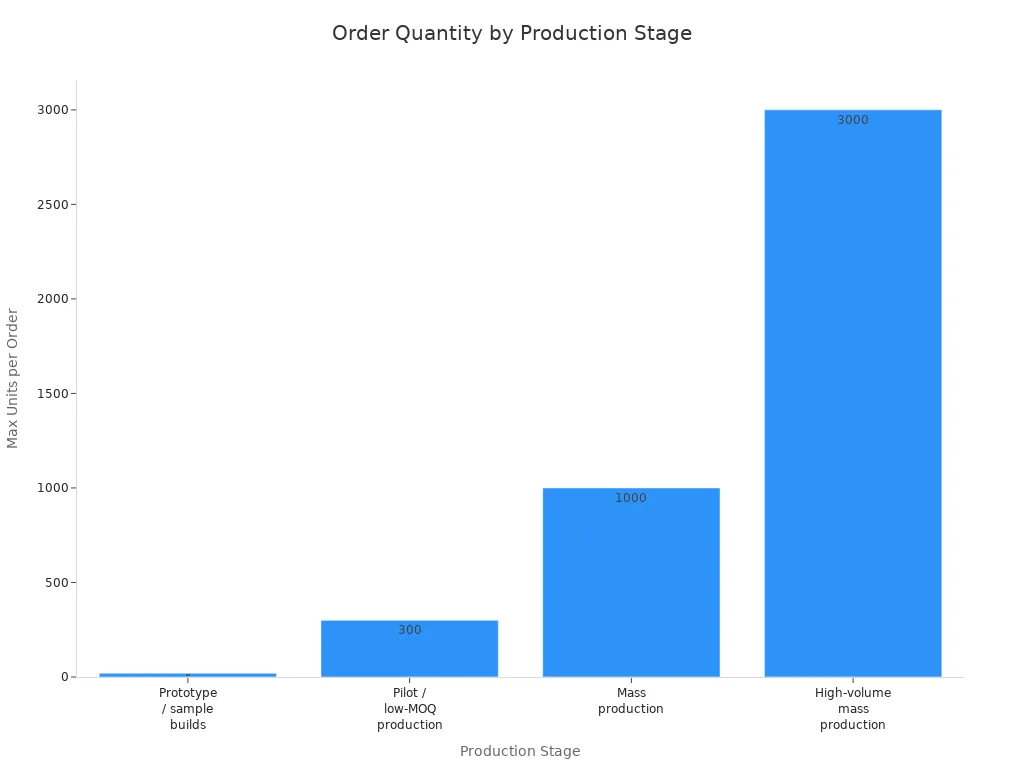
Stage | What you should use it for | Typical quantity range |
|---|---|---|
Prototype | Confirm function, test requirements, refine design, check thermal behavior, reliability, EMI, torque, and power use | 5–20 units |
Pilot production | Validate manufacturing flow, train operators, confirm test stations, improve process control, gather field feedback | 50–300 units |
Mass production | Increase output to planned volume with repeatable quality, better unit economics, and stable delivery | 500–1,000 units |
High-volume mass production | Support mature programs with predictable demand and strong forecast accuracy | 3,000+ units |
This stage logic gives you a simple map. Your prototype units prove that the motor concept works in real use. Your pilot units prove that the motor can move through manufacturing in a repeatable way. Your mass production units prove that the design can support long-term business goals.
For many teams, the biggest mistake comes from mixing stage goals. You may ask a prototype build to carry full cost targets. You may expect a pilot lot to act like mature production. That approach creates confusion. It also hides risk during exploration. A better plan uses one stage for one purpose.
Tip: You should define one main question for each stage.
Prototype: “Does the motor meet the core performance target?”
Pilot: “Can the manufacturing process hold the design window?”
Mass production: “Can the supplier deliver stable output, cost, and quality at scale?”
In electric motor projects, these definitions stay consistent across many industries. Engineers use the prototype stage to validate function and expose design issues before scale-up. Teams use pilot production to verify manufacturability, train line staff, and catch process failures early. Buyers move to mass production after validation data shows stable performance and repeatable quality.
That sequence matters even more in compact applications such as space robots. In space robots, every gram, every watt, and every motion path shape the final design. Your exploration work for space robots often starts with a very small prototype lot because the motor must fit a tight envelope and a strict power budget. Later, your development path for space robots needs pilot builds that confirm assembly control, inspection flow, and field consistency. When space robots reach launch-level readiness, your production plan must support repeatable motor output with documented performance.
You can also use stage gates to keep exploration focused:
Prototype gate: confirm torque, speed, noise, heat, and power draw
Pilot gate: confirm tooling, test fixtures, assembly yield, and process control
Mass gate: confirm forecast, capacity, logistics plan, and ongoing performance trend
This kind of structure supports better development decisions. It helps you avoid large orders before your design is stable. It also helps your sourcing team explain volume changes to finance, operations, and program managers.
Setting MOQ Milestones with INEED
You can set practical volume milestones with INEED by linking quantity to technical maturity. INEED Motors supports custom planetary gear motor development with a broad size range from 6 mm to 42 mm, custom shafts, gear ratios, connectors, and encoder options. That flexibility works best when you increase order size in steps, not in one jump.
A useful planning model looks like this:
Stage with INEED | Suggested order goal | What you should confirm before moving up |
|---|---|---|
Prototype | 5–20 units, or a negotiated small sample lot | Basic function, fit, speed, torque, power, and early performance |
Pilot | 50–100 units for many standard paths; 50–300 for early custom runs | Assembly repeatability, validation results, test method, packaging, and manufacturing readiness |
Mass production | 300–500 units for many custom launches; 500–1,000 for regular volume builds | Locked design, approved quality plan, forecast confidence, and supply alignment |
High-volume scale | 3,000+ units when demand becomes stable | Capacity planning, inventory strategy, and long-range development roadmap |
This staged model fits the way many planetary gear motor projects grow. Prototype orders often stay below standard volume levels. Pilot orders often sit around 50 to 100 units for standard models, while custom programs may expand into the 50 to 300 range. Mass orders for custom versions often begin around 300 to 500 units, then move toward 500 to 1,000 units as demand becomes firm.
You should not choose these milestones by quantity alone. You should also review supplier capability. Start with lead time. Then check scalability. Then review total cost of ownership, not just piece price. A lower unit quote may not lower your real project cost if delays hurt your schedule or if weak process control affects motor performance in the field. You should also confirm that the motor matches the required duty cycle, load profile, and power condition in your application.
INEED gives you a strong base for this planning because the company combines custom design support with structured quality control. Tool inspection, material inspection, first article inspection, key-process checks, lifetime testing, final inspection, and shipment inspection all support disciplined manufacturing. That system helps you move from exploration into formal development with fewer surprises. It also helps you protect performance when the order size grows.
For example, if you build compact actuators for space robots, you may begin with a prototype lot to verify gearbox ratio, output shaft shape, and power efficiency. Your next step may use a pilot batch to check repeatability under load. After that, you can move into a larger release once your design team confirms thermal margin, torque margin, and long-cycle performance. This path keeps exploration practical for space robots. It also keeps development tied to real data.
You can use this checklist when you define milestones with INEED:
Set the target function for the prototype stage.
Lock the key design variables before pilot volume.
Confirm power, life, and performance data in the pilot lot.
Review manufacturing capacity before mass volume.
Match forecast confidence to your buying plan.
Reserve extra room for future development in space robots programs.
That last point matters. Space robots often need long validation cycles, strict records, and careful exploration before full release. You should build your milestone plan so your motor roadmap can absorb updates without breaking the production schedule.
In practice, your best result comes from linking stage movement to facts:
Note: Move from prototype to pilot when the design works. Move from pilot to production when the process works. Move to higher volume when demand works.
This approach keeps moq ramps logical. It helps you manage cost, quality, and timing with less friction. It also gives your team a better way to scale a custom motor program through exploration, validation, and growth. When you use INEED as a supplier, you can align design choices, manufacturing readiness, and business targets in one clear path for space robots and other precision systems.
Custom Motor Engineering and MOQ Planning
Aligning Technical Specs with MOQ
You drive the success of your exploration by matching technical specs to each MOQ stage. When you start a custom motor project, you need to set clear performance targets. You must decide which components and power requirements matter most for your application. If you change gear type or modify the design, you often need new machines and custom tooling. This increases setup time and batch size. You see longer lead times and higher costs when you switch gear tooth profiles or move from one production method to another. Fixed automation works best for high-volume, single-part production. Programmable automation lets you run batch production, but you face downtime during changeovers. You should plan your exploration so you lock key specs before you scale up. This approach helps you control efficiency and performance. You avoid delays and keep your development on track.
You need to review each performance specification at every stage. You check torque, speed, and power output in the prototype phase. You confirm assembly repeatability and custom winding configurations in the pilot phase. You validate efficiency and performance in mass production. You use exploration to refine your custom motor design and ensure each component meets your goals. You build a roadmap that links engineering, development, and performance to your MOQ plan.
Tip: Always align your custom motor design with the MOQ ramp. This keeps your exploration focused and your development efficient.
Customization Options for INEED Planetary Gear Motors
You have many customization choices when you work with INEED Motors. You can select voltage range, encoder integration, and gear material based on your application. You can request custom winding configurations and custom tooling for unique performance needs. INEED supports reliable delivery and strong after-sales support. You benefit from high-performance motors that fit robotics, medical devices, smart locks, and ebike systems.
Customization Aspect | Details |
|---|---|
Voltage Range | Various options available |
Encoder Integration | Support for integration available |
Gear Material | Options vary based on application needs |
Customization Capability | Yes, with reliable delivery |
After-sales Support | Encoder integration support |
Supplier Reliability | Strong reorder rates and response times |
You use exploration to test custom motor designs and optimize components for power and efficiency. You can adjust gear ratios, output shafts, and connectors to match your performance targets. You improve development speed by working with a supplier that understands custom engineering. You gain flexibility and control over your motor roadmap. You ensure your exploration leads to motors that deliver the performance and efficiency you need.
Negotiating MOQ Ramps and Supplier Agreements
Price Breaks and Lead Times
You need a clear strategy when you negotiate moq ramps with a custom motor supplier. You can improve flexibility by building a repeat-buying relationship. Suppliers like INEED Motors often lower minimums for buyers who show consistent exploration and future orders. You can also propose a phased volume commitment. This means you agree to buy the total quantity over several releases, not all at once. The supplier sees the larger business opportunity, so you get more flexibility without a big jump in unit cost.
You may accept a modest per-unit premium for smaller runs. This helps you secure custom engineering support and early production without a major price increase. Sometimes, you can combine demand with other buyers. This approach lets you meet the supplier’s minimum while keeping your own order manageable. These practices help you balance cost, speed, and risk as you move from exploration to pilot and mass production.
You should always ask about price breaks at different volume levels. This helps you plan your design and engineering roadmap. You can match your exploration milestones to the best price points. You also need to confirm lead times for each stage. Early custom builds may take longer because of new tooling or unique power requirements. Later, as your design stabilizes, you can expect faster time-to-market and more predictable delivery.
Tip: Use your exploration data to support your negotiation. Show your supplier how your custom motor design will grow through each stage. This builds trust and opens the door to better terms.
Inventory and Capacity Commitments
You must avoid overcommitting or underplanning during ramp-up. You should review your inventory needs at each stage of exploration. For prototype and pilot runs, keep inventory low to reduce risk. As you move to mass production, work with your supplier to secure capacity commitments. This ensures your custom motor orders do not face delays when demand increases.
You need to align your engineering schedule with the supplier’s manufacturing plan. Share your forecast and design changes early. This helps the supplier adjust their power and production resources. You can also ask for buffer stock or flexible delivery windows. These steps protect your exploration timeline and support stable performance.
A strong agreement with INEED Motors includes clear terms for inventory, capacity, and custom engineering support. You get reliable supply for your custom motor program. You also gain the flexibility to adjust your design as your exploration and production needs evolve.
Quality Control in Custom Motor Production
Sample Approval and Validation
You need a clear approval path before you raise any MOQ. Sample validation gives your team proof that the motor meets design targets in real use. With INEED Motors, you can review a structured quality flow that includes tool inspection, material inspection, first article inspection, key-process checks, lifetime testing, final inspection, and shipment inspection. This quality system supports each motor build from prototype to scale-up.
A strong validation plan should check the motor under real start-stop loads. You should verify gear ratios against actual torque curves, not only paper specs. This step improves startup stability and supports better performance during larger runs. You should also confirm the allowable backlash window early.
Check heat, lubrication, and tolerance effects
Compare lost motion to system limits
Control point | Why it matters during ramp-up |
|---|---|
Automated quality control | Stops output fast if deviation appears |
Zero-defect response | Halts production to reduce defect risk |
In-process torque, speed, current, and noise checks | Protects motor consistency before batch volume grows |
Tip: Approve samples only after your application tests, life tests, and inspection records show stable quality results.
Process Consistency and Risk Management
You should treat process control as the base of a reliable motor ramp. INEED Motors uses layered quality gates across incoming materials, assembly steps, and finished goods. This quality method helps you keep variation low as order size grows. Incoming inspection of gears, shafts, and each motor supports fit control. Final checks confirm electrical condition, mechanical stability, and target performance.
Second-source planning also matters. You protect supply continuity when you qualify vendors early and document key motor materials, dimensions, and test standards.
Risk management practice | Value for supply continuity |
|---|---|
Vendor qualification | Supports stable quality and delivery |
Strategic supplier partnerships | Improves response speed |
Diversified sourcing strategies | Reduces disruption risk |
Inventory planning tools | Aligns stock with demand |
Digital supply visibility | Improves quality communication |
This approach helps you scale each motor program with confidence, stronger quality control, and better continuity.
Forecasting and Change Management in MOQ Ramps
Good forecasting helps you raise MOQ in safe steps. You do not need perfect numbers. You need a practical demand signal, a clear design freeze date, and a shared ramp plan with INEED Motors. This approach protects cost, delivery, and quality as your custom planetary gear motor program grows.
Buffer Quantities and Capacity Planning
You should set small buffer quantities at each stage. A prototype buffer covers test repeats. A pilot buffer covers yield learning. A production buffer covers demand swings. This method supports your design schedule without creating excess stock.
You also need a simple capacity review with your supplier. Ask INEED to assess equipment, labor, inventory, and response speed. Review the plan often. Update it when demand or design assumptions change.
Metric | Why you should track it |
|---|---|
Utilization rate | Shows how much available capacity is in use |
Capacity cushion | Shows how much extra room supports sudden demand |
Lead time | Shows how fast orders can move |
Throughput | Shows output speed and possible bottlenecks |
Inventory levels | Shows how well stock supports demand |
On-time performance | Shows delivery consistency |
Fill rate | Shows service level without stockouts |
Time to activate | Shows how fast added capacity can start |
A strong forecast process should also include these actions:
check actual demand against plan each month
keep flexibility for market swings
confirm service-level KPIs before each MOQ increase
align the next build with your approved design window
Tip: If your forecast confidence is low, increase buffer in small steps, not with one large order.
Change Control During Scale-Up
You should control every change once volume starts to rise. Even a small design update can affect tooling, testing, lead time, or motor fit. Write down each proposed change. Review cost, risk, and schedule impact before approval.
A simple change process works well:
define the design change
test the impact on function and production
approve the change with engineering and sourcing
release the new design revision
track the first batch closely
This process helps you protect consistency during scale-up. It also helps INEED plan material, capacity, and inspection steps around each design update.
Application Case: Custom Ebike Motor Development with INEED

Prototyping to Mass Production Success
You can learn a lot from a real-world custom ebike motor development project with INEED. You start with a clear goal: create a custom motor that fits your e-mobility design. You work with INEED to define the custom motor specs for your ebike. You test the first custom motor prototype to check torque, speed, and fit. You use this stage to see if the custom motor meets your power and size needs.
You move to the pilot phase after you approve the custom motor prototype. You order a larger batch for field testing. You check if the custom motor works well in different riding conditions. You look for any issues with heat, noise, or durability. You use feedback from these tests to improve the custom motor design. You work with INEED to adjust the custom motor if you find problems.
You reach mass production when you see stable results. You set up a clear plan with INEED for custom ebike motor development. You confirm that the custom motor meets all quality checks. You lock the design and start large orders. You see how a strong partnership with INEED supports your custom ebike motor development from start to finish.
Lessons Learned for Future Projects
You should always set clear goals for each stage of custom ebike motor development. You need to test every custom motor before you scale up. You must keep good records of each custom motor change. You should talk often with your supplier during custom ebike motor development. You need to plan for changes in demand or design.
You can use a checklist for custom ebike motor development:
Set custom motor specs early.
Test each custom motor batch.
Review custom motor feedback.
Update your custom motor plan as needed.
Confirm custom motor quality before mass orders.
You see better results when you follow these steps in custom ebike motor development. You build trust with your supplier. You make your e-mobility project a success.
You gain real value by using moq ramps for your planetary motor projects with INEED. When you align each stage of production with engineering validation and forecast confidence, you set up a strong foundation. Flexible supplier agreements help you manage production risks. You can:
Control production costs at every stage
Improve quality through each production phase
Achieve a smooth transition to mass production
Apply these strategies to ensure your production scales efficiently and reliably.
FAQ
What does MOQ mean in planetary motor projects?
MOQ stands for Minimum Order Quantity. You set this number with your supplier to define the smallest batch you can order at each stage. This helps you manage costs and plan your project steps.
How do you choose the right MOQ for each stage?
You match MOQ to your project’s needs. Start small for prototypes. Increase for pilot runs. Go larger for mass production. Use this table for guidance:
Stage | Typical MOQ Range |
|---|---|
Prototype | 5–20 units |
Pilot | 50–300 units |
Mass Production | 500+ units |
Can you customize planetary gear motors with INEED?
Yes, you can. You select voltage, gear ratio, shaft design, and encoder options. INEED supports custom engineering for many applications, including robotics, medical devices, and e-bikes.
What should you check before increasing your MOQ?
Tip: Always test your motor samples first. Check performance, fit, and reliability. Review your forecast and confirm supplier capacity. This protects your project from delays and unexpected costs.
How does INEED ensure quality during scale-up?
INEED uses strict quality checks at every step. You see inspections for materials, assembly, and final products. Automated tests and lifetime testing help you get reliable motors for every order size.