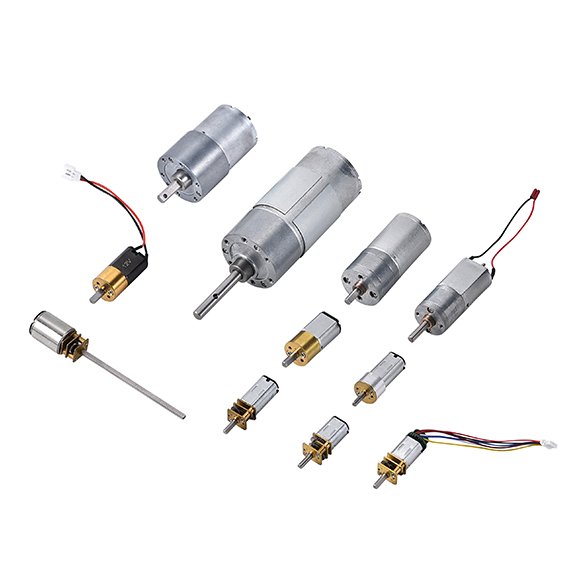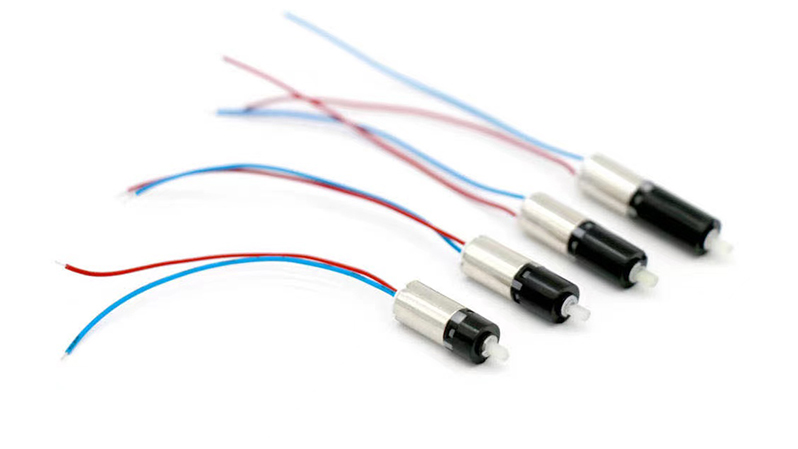
When you compare 6mm planetary gear motors, settle the naming first, because it decides whether a candidate fits at all. In this class, “6 mm” is the gearbox housing diameter: not the shaft diameter, not the gear pitch, and not the length of the assembly. A 6 mm unit is the outer bound of the whole gearbox envelope, so every other dimension you care about has to be negotiated inside it.
The forcing constraint in most extreme-envelope projects is diameter, and it is usually set by something you cannot change. A 6.5 mm instrument shaft leaves roughly 0.25 mm of wall per side around a 6 mm gearbox, which is a wall-thickness budget rather than a clearance budget. Once that number is fixed, length, ratio, torque, backlash and shaft load become the variables you trade, and each has a published ceiling at this size.
This guide follows the order a real specification gets built: what the 6 mm dimension bounds, what the installation envelope costs in length and mass, what a 6mm planetary gear motor can actually deliver in torque and speed, which applications are forced into this size, what fails and how it is prevented, how to turn an envelope into a gearbox specification, when to step up to a larger frame, and what commercial and compliance terms belong in the purchase order. Underneath all of it sits one construction choice, plastic or metal gearing, and the two are judged by different rules: the load-capacity standards for metal and plastic gears treat allowable torque differently, and the plastic side has to be calculated from geometry, temperature, speed and duty cycle rather than read from a table (plastic gear design literature, 2020).
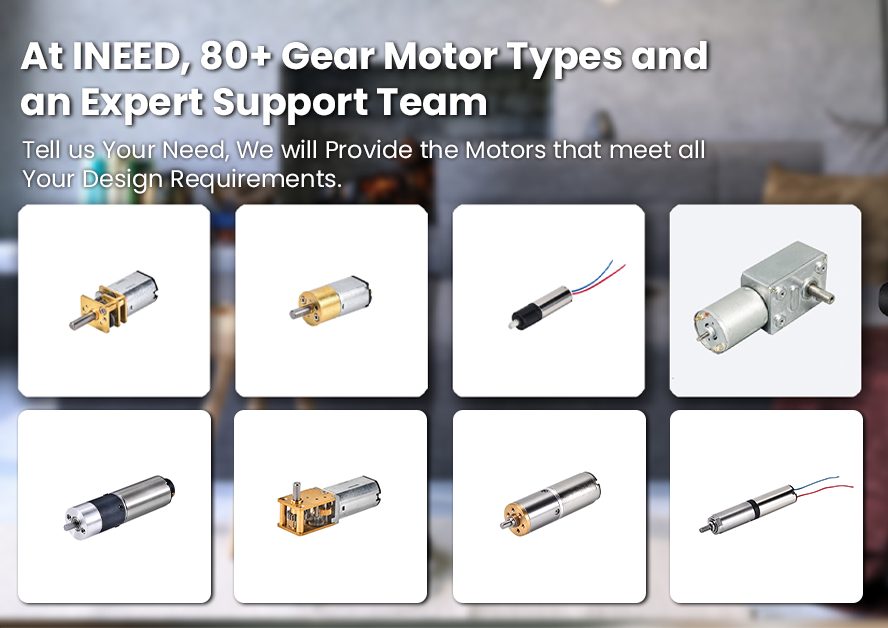
At INEED, both versions exist in the same 6 mm frame. The 6mm plastic planetary gear motor uses a 6 mm coreless motor with an LCP plastic gearhead for light loads and quiet running, while the 6mm metal planetary gear motor pairs the same frame size with a hardened all-metal gear train where higher torque and wear resistance matter. The rest of this guide uses both as the reference hardware.
What a 6mm planetary gear motor actually is, and what the 6 mm measures
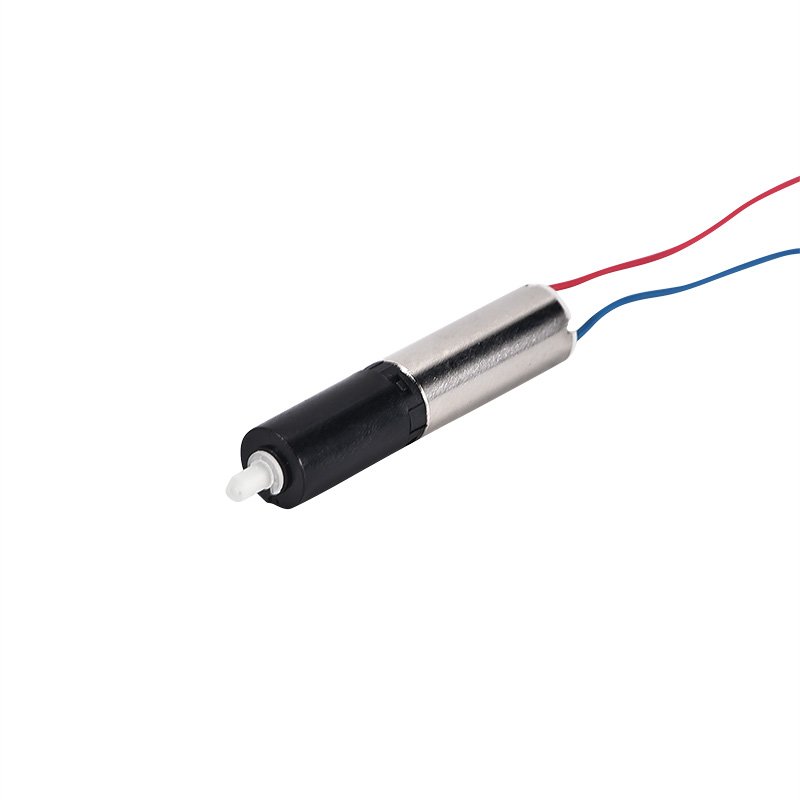
A 6mm planetary gear motor is a DC motor coupled to a planetary gearbox whose outer housing diameter is 6 mm, and that figure bounds the gearbox, not the motor body or the output shaft. Vendors publish it as an outer diameter line rather than an implied envelope, and INEED’s plastic and metal units are both specified on a 6 mm gearbox diameter, with the plastic series pairing a 6 mm coreless motor to a 6 mm plastic gearhead.
Read the diameter line or the flange drawing, never the series number. Two suppliers can present the same frame at slightly different figures depending on whether the maker rounds to the housing, so a part sold as “6 mm class” is not automatically bolt-compatible with another. The diameter line tells you whether a candidate fits the bore; the series name does not.
Inside that housing the input side is much smaller than the frame, which is why 6 mm is an envelope dimension rather than a load-bearing one.
Key Takeaway: The 6 mm figure is the gearbox housing diameter. Confirm it on the diameter line or flange drawing before you compare any torque, length or backlash number across catalogues.
The material choice inside the housing decides which standard governs the load rating. Plastic (POM or LCP) gears are the low-noise, dry-running option, while hardened metal gears carry higher torque, higher temperature and longer fatigue life. ISO 6336 covers cylindrical metal gears and expressly excludes plastic deformation and wear, and VDI 2736 is the guideline used for plastic gears, where allowable torque has to be calculated from geometry, temperature, speed, duty cycle and lubrication rather than read from a single universal limit (the load-capacity standards for metal and plastic gears, 2020).
That distinction sets the ceiling on everything the rest of this guide covers, so it belongs in your planetary gearbox selection criteria before you shortlist a frame size.
How small is the real installation envelope: gearbox length by stage count, shaft size, total length and weight
Length, not diameter, is the quantity that runs out of room in a 6mm planetary gearbox dimensions calculation, and it grows with every reduction stage you add. The INEED IND-GMBMD006 metal series publishes gearbox length and overall length against ratio, and the two do not move in lockstep: a 110.6:1 unit measures 14.5 mm at the gearbox and 28.5 mm overall, a 148.1:1 unit shares those same 14.5 and 28.5 mm figures, and a 711.0:1 unit grows to 16.9 mm at the gearbox and 30.9 mm overall, against a 14 mm motor body in every case. The ratio you need can add length unevenly, so stage count is a budget the designer spends, not a free parameter.
On the plastic side, INEED’s 6mm plastic planetary gearbox carries a ratio ladder of 5.14:1, 26.45:1, 136.02:1 and 699.55:1 across one to four stages. Because gearbox length depends on the ratio, request the per-ratio outline drawing rather than assuming a fixed length per stage.
The complete assembly is much longer than the gearbox, and both INEED families show it. The metal IND-GMBMD006 series runs 28.5 to 30.9 mm overall depending on ratio, so an extreme-envelope claim at this size is a diameter claim, and the length budget is roughly 28 to 31 mm once the motor is attached.
Stage count also sets backlash, and the trade between the two gearhead types is covered in spur versus planetary gearhead backlash.
What torque, speed, backlash and noise are achievable at 6 mm diameter
The 6mm gear motor torque ceiling depends on whether you choose the plastic or the metal gear train, and the gap between them is large. INEED’s 6mm plastic series delivers an output torque range of 5 to 200 g·cm depending on the motor and ratio, with a maximum recommended instantaneous torque of 250 g·cm that the plastic gearbox must not exceed. The 6mm metal series roughly doubles the usable ceiling: a 110.6:1 unit is rated at 54.3 g·cm, a 148.1:1 unit at 72.8 g·cm and a 711.0:1 unit at 296.9 g·cm, against a maximum rated gearbox torque of 330 g·cm and a maximum instantaneous torque of 800 g·cm. In millinewton-metres those metal figures are 5.33, 7.14 and 29.12 mN·m.
Output speed is set by the ratio you choose, not the frame. On the metal side at 3.0 V, the 110.6:1 unit runs 166 rpm no-load and 140 rpm at rated load, the 148.1:1 unit runs 124 and 105 rpm, and the 711.0:1 unit runs 26 and 22 rpm, drawing 37 to 40 mA no-load and 100 mA at rated load. The 6mm plastic series is wider still, spanning 40 to 6,420 rpm across its motor and ratio combinations.
Voltage is a third lever. Both INEED families run a 3.0 V DC typical rating inside a 2.1 to 3.6 V DC operating window, and the plastic series can also be wound for an optional low starting voltage of 0.8 to 1.2 V DC where a battery-driven product needs to wake up on a very small supply.
Backlash in this class is quoted in degrees, not arcminutes, and it is stage- and material-dependent, so treat it as a specification question rather than a fixed value. INEED’s metal design uses hardened teeth specifically to reduce backlash growth over long operation, and a miniature 6mm plastic gearbox runs looser than a precision metal one because of the small module and the composite material. A single quoted backlash value is meaningless without the stage count and the gear material attached to it.
Efficiency falls as stages accumulate, which is the constraint that most often rules out a high-ratio 6 mm design. Choose the lowest ratio that meets your torque requirement, and check the duty cycle against derating a planetary gear motor for duty cycle before you commit to a ratio.
No noise figure in dB(A) is published for a 6 mm planetary gearbox, and INEED specifies it qualitatively instead: noise is a function of stage count, rotational speed, mounting rigidity and load, so avoid running the motor at unnecessarily high speeds, mount it to reduce resonance, keep the load stable and within limits, and pick a ratio that keeps the motor away from stall.
Which extreme-envelope applications already use a 6mm planetary gear motor, and what constraint forced the choice
The evidence for 6mm planetary gear motor applications is mostly mechanism-level rather than part-number-level, and that limit belongs at the front of the section. No teardown, patent or peer-reviewed deployment found in this research names a specific 6 mm gear motor inside a specific device. The application classes that circulate, smart locks, pop-up camera modules, VR headset adjustment, surgical staplers, infusion pumps, dexterous hands and micro AGVs, are described here as envelope problems rather than documented bills of materials. So what follows describes the mechanism class and the constraint that forces the diameter, not a named product.
Key Takeaway: No teardown, patent or peer-reviewed deployment in this research names a 6 mm unit inside a named device. Treat the application classes below as envelope descriptions, and the constraint arithmetic as the part you can actually design against.
The primary case is a powered surgical or diagnostic instrument drive inside a roughly 6.5 mm shaft envelope, and the arithmetic is the proof. A 6 mm gearbox in a 6.5 mm shaft leaves about 0.25 mm of wall per side, which is the kind of budget that removes every larger frame size from the discussion before torque is even considered. The diameter forces the choice; the length is what the designer then has to spend. This is where INEED’s plastic and metal 6mm families both land: between them they cover output torque from 5 g·cm up to 296.9 g·cm and output speed from 22 rpm to 6,420 rpm, all inside the same 6 mm envelope.
The same trade-off appears in robotic finger joints, documented in mechanism terms rather than part numbers. Backlash there is the lost motion on reversal, and pushing a very high ratio to extract large torque from a tiny motor multiplies both backlash and reflected inertia, which makes the joint feel spongy. Direct drive removes backlash but needs a much larger, heavier motor that does not fit a finger envelope, so a small high-speed coreless motor with a compact planetary gearbox is the standard high-torque-density answer. INEED’s plastic series is built on exactly that pairing, a 6 mm coreless motor with a 6 mm plastic gearhead, and its neodymium-magnet coreless motor is quoted at 6 to 700 times the load capacity of a same-sized 6mm brushed motor without gearing.
Where the envelope is not this tight, the friction penalty of a high-ratio micro drive grows quickly, and any real hand or joint design has to budget for it in the validation test rather than the datasheet. The point of the mechanism classes below is the same in every case: the forcing constraint is a housing diameter that cannot grow, and the specification question is how much length and how many stages the envelope can afford. For how these mechanisms are built in production, see planetary gear motors in real product mechanisms.
What fails at this size, and how each failure is prevented
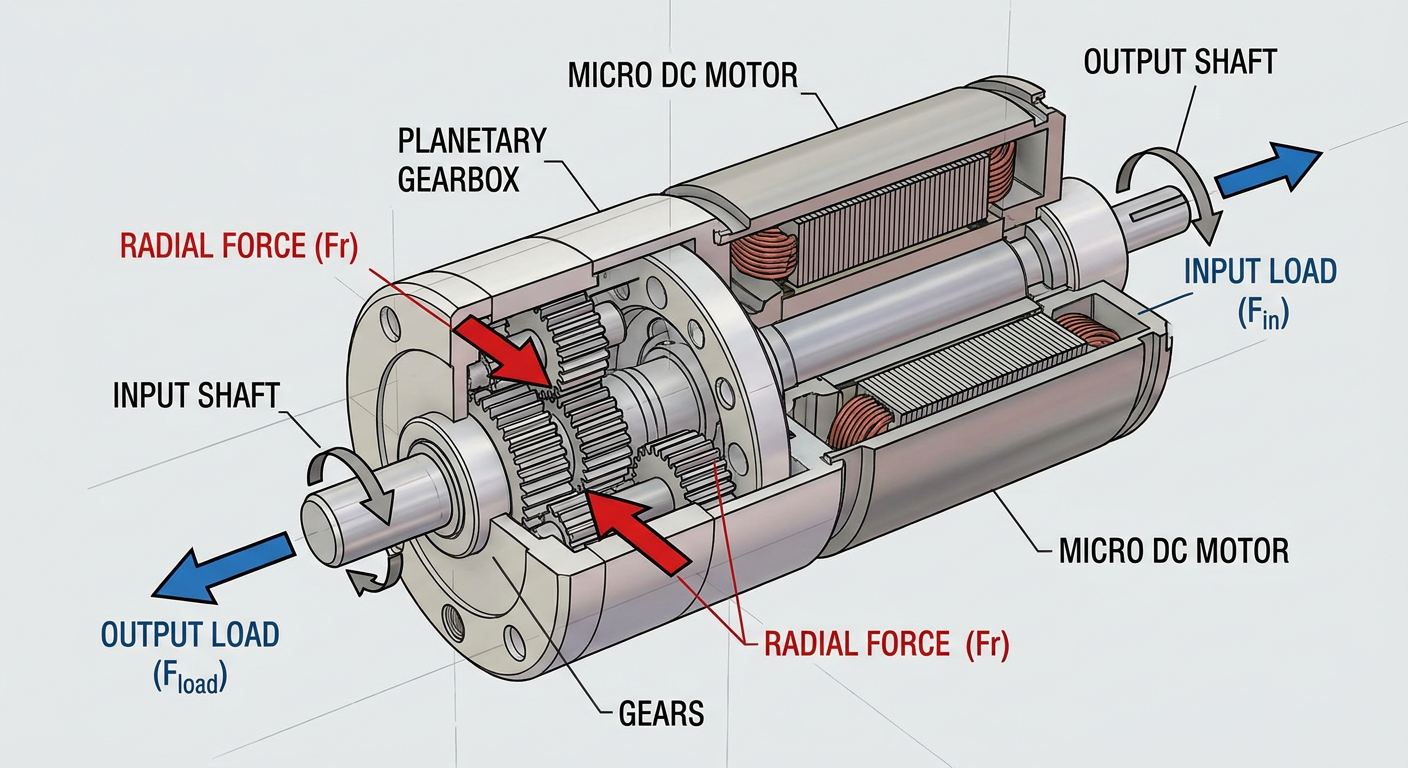
The failure that precedes tooth damage at 6 mm is output-bearing overload, and it is caused by loads the catalogue torque rating does not include. Belt tension, overhung load, press-fit force, lead-screw thrust and side-loaded wheels all load the output bearing rather than the gear teeth, producing shaft wobble, rising noise, rising current and uneven tooth contact, with tooth damage following bearing-hole ovalisation. The fix is never a stronger tooth: change the gearbox frame size, the output version or the bearing arrangement, because the bearing, not the gear mesh, is what is being exceeded (the load limits on the output shaft).
The permissible limits are small, and at this frame size they should come from the supplier drawing for your exact configuration rather than from a general figure. INEED publishes datasheets, 2D/3D drawings and outline drawings on request, so the axial and radial load limits for the specific plastic or metal unit you intend to buy belong in that request. A few newtons is roughly the weight of a small coin stack, which is why a lead-screw thrust or a belt tension that would be trivial on a 20 mm gearbox is a design error here.
Failure mode | Trigger | Criterion | Prevention |
|---|---|---|---|
Output-bearing overload | Belt tension, overhung load, press-fit force, lead-screw thrust, side-loaded wheels | Axial and radial limits from the supplier drawing for the exact configuration; a few newtons at this frame | Change frame size, output version or bearing arrangement |
Lubricant film collapse and micro-pitting | Continuous load above the sample-review assumption; intermittent duty becoming long repeated operation; low temperature reducing effective grease viscosity; repeatedly driving a high-ratio box into an end stop | No numeric service factor published; specify continuous and peak torque separately | Specify exact duty cycle including start-stop frequency and rest time; move up a frame size when there is no validation margin |
Positioning shortfall | Backlash at 6 mm is measured in degrees, not arcminutes | Sub-degree positioning cannot be met open-loop | Add an external encoder loop |
The second chain is lubricant film collapse leading to micro-pitting, triggered by continuous load above the assumption used during sample review, by a duty change from intermittent to long repeated operation, by temperature lowering effective grease viscosity, or by repeatedly driving a high-ratio box into an end stop. Preventing both chains comes down to specification practice rather than hardware: specify the exact duty cycle including start-stop frequency and rest time, and specify maximum continuous torque and peak stall torque separately, because catalogue torque ratings do not include real load-path effects such as side loads. On INEED’s plastic series the penalty for ignoring this is explicit, since stalling or overload will damage the winding and brush within a few seconds, and the plastic gearbox must not see more than 250 g·cm instantaneously.
No rated lifetime or MTBF figure in hours is published for INEED’s 6 mm frames, and no numeric service factor is published either. INEED states only that lifetime depends mainly on working voltage, duty cycle, load/torque and stall events, so a life claim at 6 mm has to come from your own validation testing rather than from a datasheet.
How to convert an installation envelope into a 6 mm gearbox specification
Miniature planetary gear motor selection at this size is a five-step conversion from measured envelope to ordered part number, and the first step eliminates most candidates. Measure the available diameter and the available length separately: diameter sets the frame size, length sets the ratio you can afford. For the wider comparison this method sits inside, see micro DC motor selection for OEMs.
Step one, take the measured envelope. A 6.5 mm bore accepts the 6 mm frame with roughly 0.25 mm of wall per side, and nothing larger fits.
Step two, convert available length into a ratio. On INEED’s metal series a 110.6:1 or 148.1:1 unit needs 14.5 mm of gearbox and 28.5 mm overall, while a 711.0:1 unit needs 16.9 mm of gearbox and 30.9 mm overall, all against a 14 mm motor body. On the plastic series the ladder runs 5.14:1, 26.45:1, 136.02:1 and 699.55:1, so match the ratio to the length budget before you commit.
Step three, read the ratio and torque that the choice delivers, and pick the plastic-versus-metal branch here. Plastic output torque spans 5 to 200 g·cm with a 250 g·cm instantaneous ceiling; metal delivers 54.3 g·cm at 110.6:1, 72.8 g·cm at 148.1:1 and 296.9 g·cm at 711.0:1, with a 330 g·cm rated and 800 g·cm instantaneous gearbox limit. If your required torque sits above the plastic ceiling, the metal gear train is the answer rather than a longer plastic stack.
Step four, compare against required continuous torque with margin, and check the speed budget alongside it. The metal series runs 166 rpm no-load down to 22 rpm rated-load across its ratios, while the plastic series spans 40 to 6,420 rpm. Where torque, bearing load, thermal rise or life target leaves no validation margin, the next frame size is the answer rather than a longer ratio stack.
Step five, verify the shaft load path against the drawing for your exact unit, and confirm the mechanical interface: INEED’s plastic series ships a standard 2.0 mm D-shaft flattened by 0.5 mm plus an optional 1.5 mm round shaft 8.05 mm long, so match the shaft to the coupling before you finalise. A belt tension or press-fit force is where the design changes.
One worked configuration: the 6mm plastic planetary gear motor combines one of four 6mm coreless motors with one of four reduction boxes for 16 standard options, weighing only 1.25 g, and more than 80 percent of INEED projects end up customized on dimensions, internal structure, technical parameters, encoders or accessories. Shaft, winding, ratio, encoder, wire length and connector are all open to specification, so ask for the drawing and performance curve for your exact build.
Talk to an expert about your envelope. Send the bore, the length budget and the continuous torque target, and get a configuration back.
When to step up to metal, or to a larger frame, and what the step buys
The first step up is not a frame size at all, it is the move from plastic to metal inside the same 6 mm envelope. That change roughly doubles the usable ceiling without costing any bore diameter: INEED’s plastic series tops out at 200 g·cm continuous with a 250 g·cm instantaneous limit, while the metal series rates 296.9 g·cm at 711.0:1 against a 330 g·cm rated and 800 g·cm instantaneous gearbox limit. If your required torque sits above the plastic ceiling but inside the metal one, switching gear material fixes the problem without a single millimetre of extra housing.
The second step up is the frame size itself, and it is a margin test rather than a preference. Move to a larger frame when torque, bearing load, thermal rise or life target leaves no validation margin. If your required continuous torque is 100 g·cm and the plastic ceiling is 200 g·cm, you have margin; if it is 190 g·cm, you do not, and you either take the metal 6 mm unit or move up a frame. The torque available per millimetre of diameter is steep at this scale, which is why the 6 mm frame should be chosen because the envelope demands it rather than because it is the smallest option.
The plastic-versus-metal split also decides how the part behaves over time, not just how much it can carry, and the efficiency and backlash trade between gearhead types is worth settling alongside it. Plastic gears are lighter and quieter and suit light, intermittent loads; hardened metal teeth resist wear, hold efficiency and torque output over a longer life, and handle repeated cycling and intermittent peak loads with less wear. INEED’s plastic series weighs only 1.25 g, which matters when the object being driven is itself a few grams.
Whichever step you take, it has to be made before the enclosure is tooled. A larger gearhead is not a drop-in replacement for a 6 mm one, and even the plastic-to-metal swap can change the shaft and interface details, so settle the material and frame decision on paper first.
For the wider decision this frame-size step sits inside, see the planetary gearbox selection guide.
What compliance, customization and lead-time terms an OEM should specify
Compliance terms for a 6 mm gear motor depend on the end market, and the two regulatory tracks that matter most are quality systems and substance restrictions. On the quality side, FDA’s Quality Management System Regulation took effect on 2 February 2026 and incorporates ISO 13485:2016 by reference at 21 CFR 820.7(b), so a gear motor sold into a US medical device channel is bought under an ISO 13485 quality system with a documented design-transfer and traceability trail (the quality-system rule that took effect in February 2026, effective 2026-02-02). ISO 13485:2016 itself is the third edition dated 2016-03-01 (the ISO catalogue entry for the standard, 2016-03).
On the device-safety side, IEC 60601-1 Edition 3.2 (2020-08) is the consolidated general-safety-and-essential-performance standard for medical electrical equipment, and FDA recognizes it complete with US national differences applied under recognition number 19-49, listed in recognition list 060 with a date of entry of 03/04/2023 (the medical electrical equipment base standard, 2020-08 standard). A 6 mm gear motor inside a surgical or diagnostic handpiece has to support that standard, which means the supplier needs to be able to document the motor’s contribution to the device’s safety case.
On substance restrictions, RoHS restricts ten substances and applies to all products with an electrical and electronic component unless specifically excluded, with the restricted list covering lead, cadmium, mercury, hexavalent chromium, PBB, PBDE and the four phthalates DEHP, BBP, DBP and DIBP (the substance limits a motor declaration has to meet, consolidated version dated 2025-01-01). The maximum concentration values are assessed per homogeneous material, and the numeric thresholds are set out in Annex II of the Directive rather than on the Commission’s topic page, so ask the supplier for a declaration that cites the Annex II limits rather than a general statement of compliance.
Customization is where a 6 mm specification is actually won or lost, because the standard catalogue rarely matches the envelope exactly, and at INEED more than 80 percent of projects end up customized. The dimensions that matter at this size are output shaft geometry (the standard 2.0 mm D-shaft, or the optional 1.5 mm round shaft), rated voltage and winding inside the 2.1 to 3.6 V DC window or a 0.8 to 1.2 V DC low-start winding, gear ratio, encoder specification, internal structure, wire length and connector type such as JST. Each of these changes the tooling and therefore the commercial terms.
Lead time and support terms should be written into the purchase order rather than assumed. INEED quotes an engineering response time of 8 hours for all requests, and publishes datasheets, outline drawings, 3D STEP models, performance curves under different voltages and material and reliability test summaries on request, so the commercial and technical details for your exact configuration come back in one pass.
Quality documentation should be specified as a deliverable, not requested after the fact. INEED runs 100 percent final inspection before shipment, holds a finished-goods acceptance yield at or above 98 percent, a DPPM defective rate at or below 200, customer satisfaction at or above 98 percent, and a 60 percent automation rate across its manufacturing. That is the level of documentation and process control a medical or industrial customer should ask to see in the supplier quality plan.
If your product is regulated, pair these substance declarations with the supplier quality-system documentation covered in the micro DC motor selection guide for OEMs.
Frequently Asked Questions
What does the 6 mm in a 6mm planetary gear motor measure?
It measures the gearbox outer housing diameter. Shaft diameter and gear pitch are separate lines on the same datasheet, and they are usually much smaller than the frame number. A 6mm planetary gearbox dimensions table will list the housing at 6 mm and then give shaft diameter, shaft protrusion and overall length separately, so the frame figure alone tells you nothing about the interface you have to design around. Naming conventions also vary between suppliers, which is why the housing diameter line is the one to read, not the series number.
How much torque can a 6mm gear motor hold continuously?
It depends on the gear train you pick. INEED’s 6mm plastic series works in a 5 to 200 g·cm continuous band depending on the motor and ratio, with a hard 250 g·cm instantaneous ceiling, while the metal series rates 54.3 g·cm at 110.6:1, 72.8 g·cm at 148.1:1 and 296.9 g·cm at 711.0:1 against a 330 g·cm rated and 800 g·cm instantaneous gearbox limit. Whatever the figure, it is only meaningful with a duty cycle, ambient temperature and input speed attached, so ask what the number assumes before comparing two datasheets.
Why not just specify a 711:1 ratio to get more torque?
Because reduction multiplies torque only up to the point where the gear train’s own limits take over. At 6 mm, the binding constraints are the strength of the smallest planet gears, the load the output bearing can carry, and the heat the motor can shed at low output speed. A very high ratio also collapses output speed, so the motor runs near stall, where efficiency drops and thermal rise climbs. On INEED’s metal line, 711.0:1 carries the highest torque but only 22 rpm at rated load, so if a design needs more torque than the 330 g·cm rated limit, the honest answer is the metal gear train or a larger frame, not a longer gear stack.
Can a 6mm planetary gear motor hold position without an encoder?
Not reliably, and not to a defined accuracy. Backlash in this class runs into degrees, so any open-loop position command has an uncertainty band wider than most positioning tasks can tolerate. The gear train also has no way to report that it has slipped. A 6mm planetary gear motor can repeat a commanded move reasonably well when it always approaches from the same direction and the load is light and constant, but that is repeatability under fixed conditions, not holding. Where position matters, close the loop with an external encoder, which INEED can fit as a customized option, or add a mechanical hard stop the drive can stall against.
How long does a 6mm planetary gear motor last?
No MTBF or L10 life figure is published for INEED’s 6 mm frames, so any single number you are quoted should be treated with suspicion. The reason is that life here is dominated by application variables rather than by the gearbox: output torque as a fraction of the continuous rating, working voltage, duty cycle, and whether the load is steady or shock-loaded. INEED states that lifetime is mainly affected by working voltage, duty cycle, load/torque and stall events, so the practical approach is to define your own duty cycle, run the sample to failure under it, and treat that result as your life figure.
When is metal or a larger frame the right answer instead of plastic 6mm?
Take the metal 6 mm unit when your torque or wear demand sits above the plastic ceiling of 200 g·cm continuous and 250 g·cm instantaneous, and step to a larger frame when even the metal unit leaves no margin on torque, bearing load, thermal rise or life target. Both steps are worth taking early, before the enclosure is tooled, because neither is a drop-in replacement for the plastic 6 mm part. The metal gear train buys roughly double the torque ceiling with no extra bore diameter, while a larger frame buys more room for the output bearing and better heat rejection at the cost of a few millimetres of diameter. If your worst-case load sits above roughly half the 6 mm continuous rating, or your duty cycle is close to continuous, specify metal or the larger frame from the start.
What compliance documentation should an OEM request with a 6mm planetary gear motor sample?
Ask for the RoHS and REACH declarations for the exact part number, not for the product family, plus the ISO 9001 certificate of the manufacturing site that will actually build your order. RoHS and REACH declarations are issued per part because material content changes with plating, magnet grade and lubricant, so a family-level statement does not cover your configuration. Beyond the certificates, request the inspection records your supplier runs by default, and confirm in writing which of them will accompany each shipment. If your product is regulated, ask early whether the supplier can support the specific test reports your approval body will want, because that capability varies between vendors.
Conclusion
The 6 mm frame is a diameter-driven choice, and the specification that follows from it is a series of published ceilings rather than a set of preferences. Both INEED families share the 6 mm gearbox diameter; the metal series runs 14.5 to 16.9 mm at the gearbox and 28.5 to 30.9 mm overall against a 14 mm motor body, on ratings of 54.3 to 296.9 g·cm. The plastic series spans 5 to 200 g·cm at 1.25 g of gearbox mass, and the two together cover 22 to 6,420 rpm of output speed.
The decision framework that follows is short. Measure the envelope, convert available length into a ratio, choose the plastic or metal gear train on the torque demand, check the speed budget as well as the torque budget, and confirm the shaft interface against the drawing. If any of those checks leaves no margin, take the metal unit or step up a frame size before the enclosure is tooled, because the cost of a late change is higher than the cost of settling the material early.
Two evidence limits are worth carrying into the specification meeting. No source reviewed here names a specific end product using a 6 mm gear motor, so the application cases are mechanism-class arguments rather than documented deployments. And no rated lifetime in hours is published for this frame size, so a life claim has to come from your own validation testing under your own duty cycle.
The next step is to take the envelope measurements and the duty cycle to INEED and ask for the length, torque, backlash and shaft-load drawing for the specific configuration, plus the compliance declarations your end market requires.
Before you sign off, re-check the shaft load path against the radial force limits on gear motor shafts and confirm every number on the drawing for your exact configuration.